How to play
The rules of
SLOVARIЦA
Everything you need to know in one place: the map, the sounds, the tokens, movement, and how it all works together. Sound descriptions are available in the Guidebook.
01
Quick Overview
Slovarica is a musical board game built around the human voice.
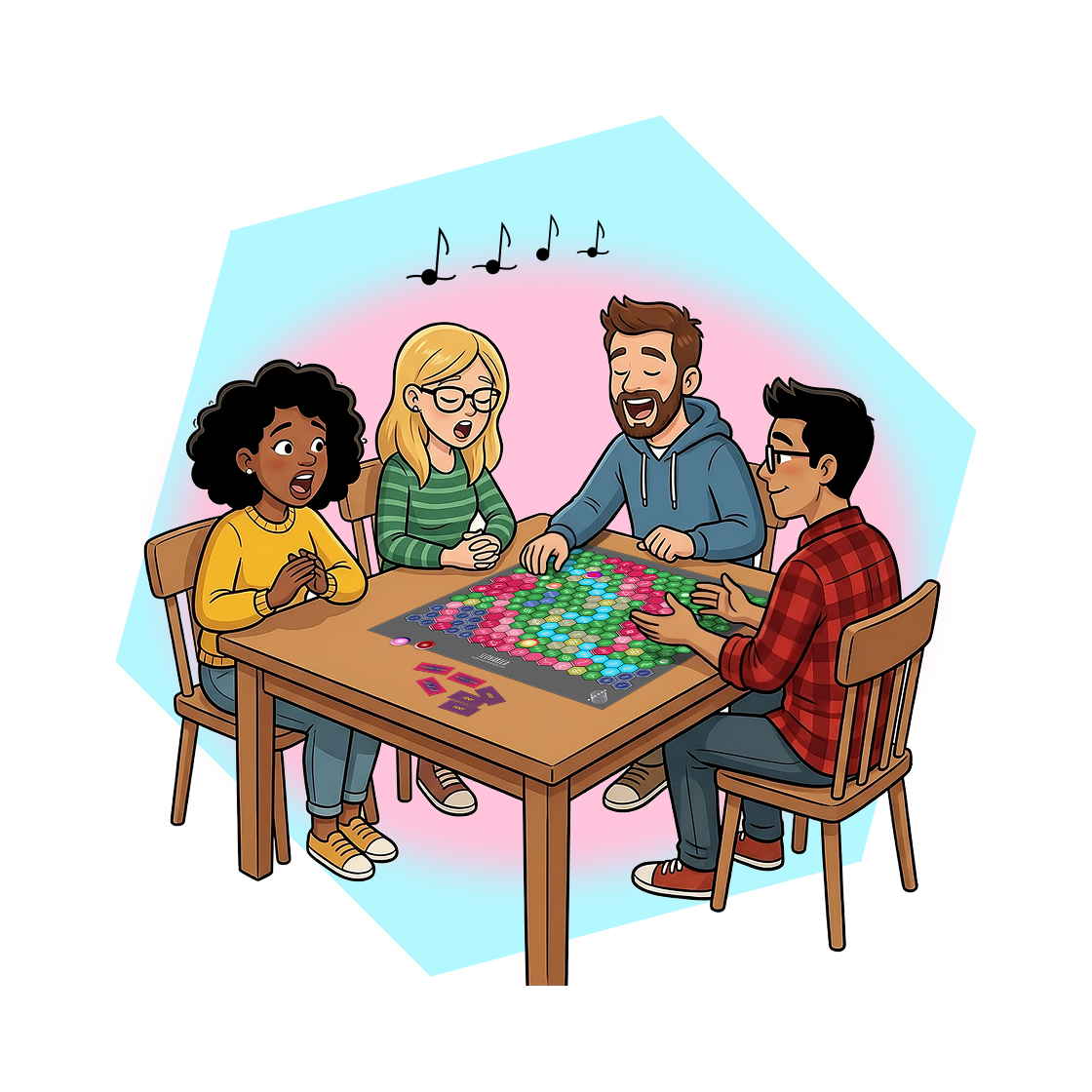
The goal of Slovarica is to create and maintain an evolving musical improvisation together with other players as long as possible. Participants explore the map, learn different vocal techniques and sing together. Moving their tokens across the map, from one tile to another, they sound out each tile as they go.
A session ends when all players agree it has reached a natural conclusion, or after a pre-agreed number of rounds. The game does not end with a winner. It ends with a silence.
There are no winners and no losers — only the challenging goal to make music together without a prior plan. Each session is unrepeatable. Each player contributes to a shared sonic landscape that dissolves when the game ends.
Gameplay snippet
0:00 / 0:00
02
Setup
Place the map on a smooth, flat surface. Prepare tokens and Hint cards. Each participant should choose a personal token and place it on any of the blank tiles on the map. Multiple players may start from the same blank tile at the same time. Take a moment to embrace the silence and make the first move.
03
Safety Measures
Although Slovarica favours exploratory spirit and thrives on enthusiasm, your voice is a physical instrument. Handle it with care! A few precautions will keep your performance safe and enjoyable.
Warm Up
- Always warm up your voice before singing — gentle humming, lip trills, scales
- Never approach demanding techniques or extreme ranges without warm-up
Hydration
- Drink enough water — vocal cords need to stay moist
- Avoid caffeine and alcohol before singing, as they dehydrate
Posture & Breath
- Straight spine, relaxed shoulders for full breath support
- Inhale through the nose "to the belly" without lifting the shoulders
- Support breath from the diaphragm
No Strain
- Do not push your voice beyond its comfortable range
- Rest your voice after extended singing sessions
- If your voice feels tired or hoarse — stop
Body Signals
- If dizzy or lightheaded — stop making sounds and sit down
- Never "sing through" pain — it is your body's warning signal
Restrictions
- Avoid singing with a sore throat, respiratory infection, or similar condition
- Do not play in dusty or smoky environments
- Avoid singing for at least two hours after waking up
⚠ Disclaimer
Exercise with caution!
Slovarica involves vocal exercises that may strain your voice. If you experience pain, hoarseness, or discomfort, stop immediately. Consult a doctor before playing if you have any pre-existing vocal or respiratory conditions. Please be aware that you participate at your own risk. Take care of yourself and enjoy the game mindfully!
04
Gameplay
Represented by their tokens, players travel across the map and make sounds that they discover on the tiles along the way. Each tile bears a letter or symbol indicating the sound that players should make while standing on it. Having moved to another tile, a player should change the sound according to the new tile.
All players make sounds together at the same time as an ensemble. Hence, players become a group of singers who explore and learn various sounds to create an evolving composition of noises, melodies and rhythms.
Players need to listen carefully to other participants and try to merge their singing with the rest of the group to enrich the shared experience. Making sounds is only allowed while occupying a particular tile on the game map and within the range of the given sound.
One game session may last from five minutes to an unlimited period of time, provided the participants commit to it.
05
The Map
The game map represents the landscape of the northern Balkan region, along with some neighbouring territories. Check the list of featured Landmarks below
It is a grid of 248 hexagonal tiles arranged in a comb pattern.
Each tile displays letters and symbols that refer to specific sounds. Find more about Sounds below.
- 248 hex tiles across four terrain zones
- Each tile carries one letter or symbol of a particular corresponding sound
- Tile colours indicate terrain type
- Tokens mark your position on the map
06
Terrain Types
The map contains four terrain types. Each terrain has its own movement restrictions and its own sonic character. Learning the terrain is not necessary at the beginning.
Green
Flatland. Generally, alphabetic letters. Good for beginners and for building momentum.
Blue
Water. Generally, vowels.
Red
Highland, arranged across three elevation levels: light red indicates the first layer, and dark red stands for the uppermost
Yellow
Urban areas, i.e. capital cities and surrounding outskirts. The most harsh and dense zone on the map.
07
Landmarks
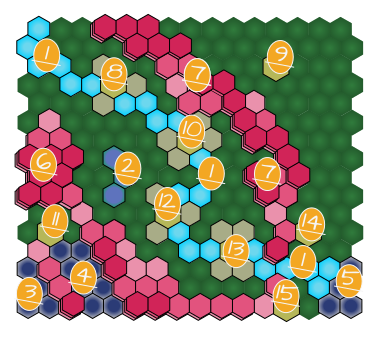
The map represents the landscape of the northern Balkan region and some neighbouring territories. The following locations are featured across the map:
- River Danube
- Lake Balaton
- Tyrrhenian Sea
- Adriatic Sea
- Black Sea
- Alps
- Carpathians
- Vienna
- Warsaw
- Bratislava
- Venice
- Budapest
- Belgrade
- Bucharest
- Sofia
Not sure how it works?
Try the online sampler — no account, no download
08
Movement
Players may move their tokens across the map in any direction and in any order, unless a specific game mode instructs otherwise. In a single move, a player can cross up to 3 green tiles, up to 6 blue tiles, and just 1 tile when moving through red tiles.
Red tiles rise across 3 levels which creates obstacles to direct movement. Players cannot jump from non-mountain terrain to an upper mountain level, nor skip over it. Players need to start low and ascend through each level step by step.
City tiles function as teleporters, letting players instantly travel between them and continue their journey from another part of the map. Keep in mind that only one player can occupy each tile at a time.
- Green — up to 3 tiles in a single move
- Blue — up to 6 tiles in a single move
- Red — only 1 tile at a time, ascending level by level
- Yellow — city tiles teleport: travel instantly between them
- Blank tiles are designed for pauses
09
Personal Tokens
Each player needs a personal token to represent them on the map. Coins, pebbles, gems, bottle caps, corks, toy figures and similar objects - anything clean and small that fits within a tile and does not damage the map.
- Tokens have no effect on gameplay.
- Tokens simply mark the position of a player as they move across the map.
10
The Sounds
Sounds are an essential part of Slovarica and serve as basic material for improvisation. Think of them as a colour palette: each sound features different qualities and significantly influences the musical result. Sounds of the game can be divided into two groups: speech sounds and non-speech sounds.
There are three ways to learn the sounds of the Slovarica game:
- Learn from more experienced players
- Learn by reading the Sound Descriptions in the Guidebook
- Learn by interacting with a digital copy of the Slovarica map (follow the link in the Guidebook)
Although most sounds in Slovarica are elementary and suitable for everyone, some tiles carry sounds that may strain your voice if performed carelessly (refer to Safety Measures).
I. Speech Sounds
These sounds, called phonemes, are drawn from various languages spoken in the Balkan region, neighbouring areas, and beyond. They are marked by letters of the local alphabets. If you are not familiar with a particular letter, try to approximate it (e.g. Ä = A).
II. Non-Speech Sounds
These sounds are made up of vocal noises, also known as extended vocal techniques (e.g. hissing, whistling, buzzing, etc.), and body percussion sounds. They are marked by unique symbols.
Both sound groups welcome all possible interpretations, nuances, and variations within the proposed way of articulation.
In the Guidebook
Full sound descriptions
The complete phonetic reference — all 248 sounds, how to produce them, and how they behave in each terrain — is available in the printed Guidebook. You can get it with the game bundle or as a PDF file.
11
Pauses
Pausing is a good opportunity to listen to other players. Blank tiles with no symbol on them allow for a pause to rest, without withdrawing from the game completely.
When occupying a blank tile, a player should not make any sound.
12
Duration
The duration of one game session is not limited. It can last from whatever it takes to cross a couple of tiles up until the stars fall from the sky. The session ends with general silence when all players agree the gameplay has reached a natural conclusion.
The recommended duration of one game session for beginners is 30 minutes. After that, there may be a brief feedback session, a little break, or another session immediately. However, longer sessions (up to 3–5 hours) have been known to yield deep, transformative experiences.
13
Recommendations
- Play in quiet spaces with favourable acoustics where every sound can be heard clearly and distinctly
- Move across the map at an unhurried pace, lingering on each tile and listening closely, giving full attention to the evolving soundscape
- Close your eyes and let yourself go — let rhythm guide you, draw on familiar melodies, and bring in the tunes you love
- Variations in sound and personal interpretation are encouraged — find your own way of performing each technique and adjust it to the overall ambiance
- Pay attention to how your sound blends with others, balancing loudness and softness to serve the whole group
- Aim to create a musical atmosphere that feels connected and unified, one that encourages and supports every other player
- Share your impression with others when the game session is over — feedback is an important part of Slovarica
Wishing you a pleasant sonic journey!
14
Solo Mode
In solo mode, Slovarica becomes a personal instrument and reference tool. There are no turns, no opponents, no structure imposed from outside. You move at your own pace across the map, activating tiles, building and dissolving textures.
Solo play is how most people first encounter the game. It is also the mode used for practice, for learning the sounds, and for using the map as a warm-up tool before group sessions.
The online solo sampler (248 tiles) is available free at any time. No account required.
Try solo now
248 tiles · no account · start immediately
15
Multiplayer Mode
In multiplayer mode, up to twenty players share the same map in real time. Each player controls their own token and activates tiles independently — but everyone hears the full result of all active tiles simultaneously.
- Up to 20 players per session
- All players share the same map in real time
- Each player activates tiles independently
- The combined result is the composition — unplanned, unrepeatable
Try multiplayer now
Real-time · up to 20 players · no account needed
16
Modes
Each mode offers a different way to experience Slovarica and influences the game flow, player behaviour, and rules. There are 9 various modes that participants may select from before the game begins.
To select from the list of modes, read their descriptions and discuss what fits the group of participants best. All participants must agree on one mode and follow its rules throughout the game session.
Slovarica was originally designed for the Wanderer mode.
Wanderer
Goal: maintain musical soundscape as long as possible
This is the original mode that encourages participants to challenge their creativity, advance their musical skills, and help onboard new players who may learn from more experienced peers on the go.
Move calmly across the map in any order according to a personal creative vision. Listen closely to the other participants. Choose tiles that might enrich the overall composition. Incorporate rhythms and melodies. For best results, pay attention to the harmony and dynamic balance.
The outcomes of this mode are entirely dependent on the commitment of each participant. Above all, have fun and enjoy the sounds!
Remember that the beauty is in the ears of the listener. If you forget the sound of a tile, refer to the Sound Descriptions in the Guidebook or visit the website to find that tile on the map, click on it and listen to a sound sample.
17
Sound Descriptions
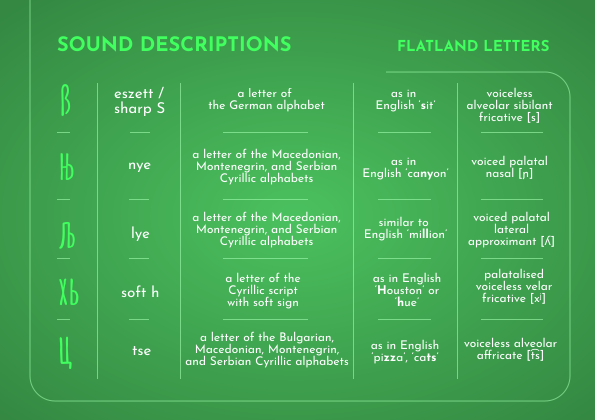
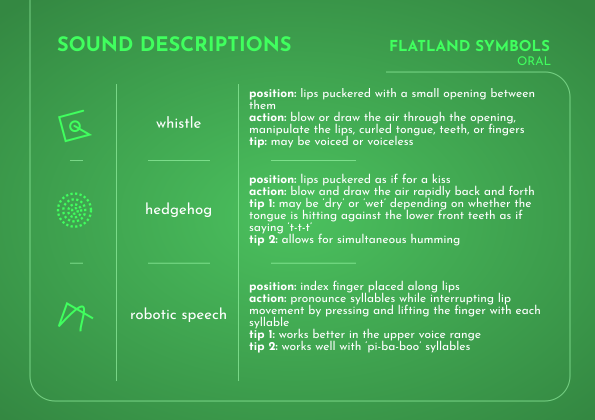
The complete list of symbols, vocal techniques and phonemes is included in the Guidebook and available within the full game bundle or as a PDF file. Alternatively, all the sounds of Slovarica may be learnt online while strolling around one of the Digital Maps.
Learn OnlineExcited to play?
Get the physical game — from €10
Curious how we do it?
Watch the gameplay video on the About page